Summary
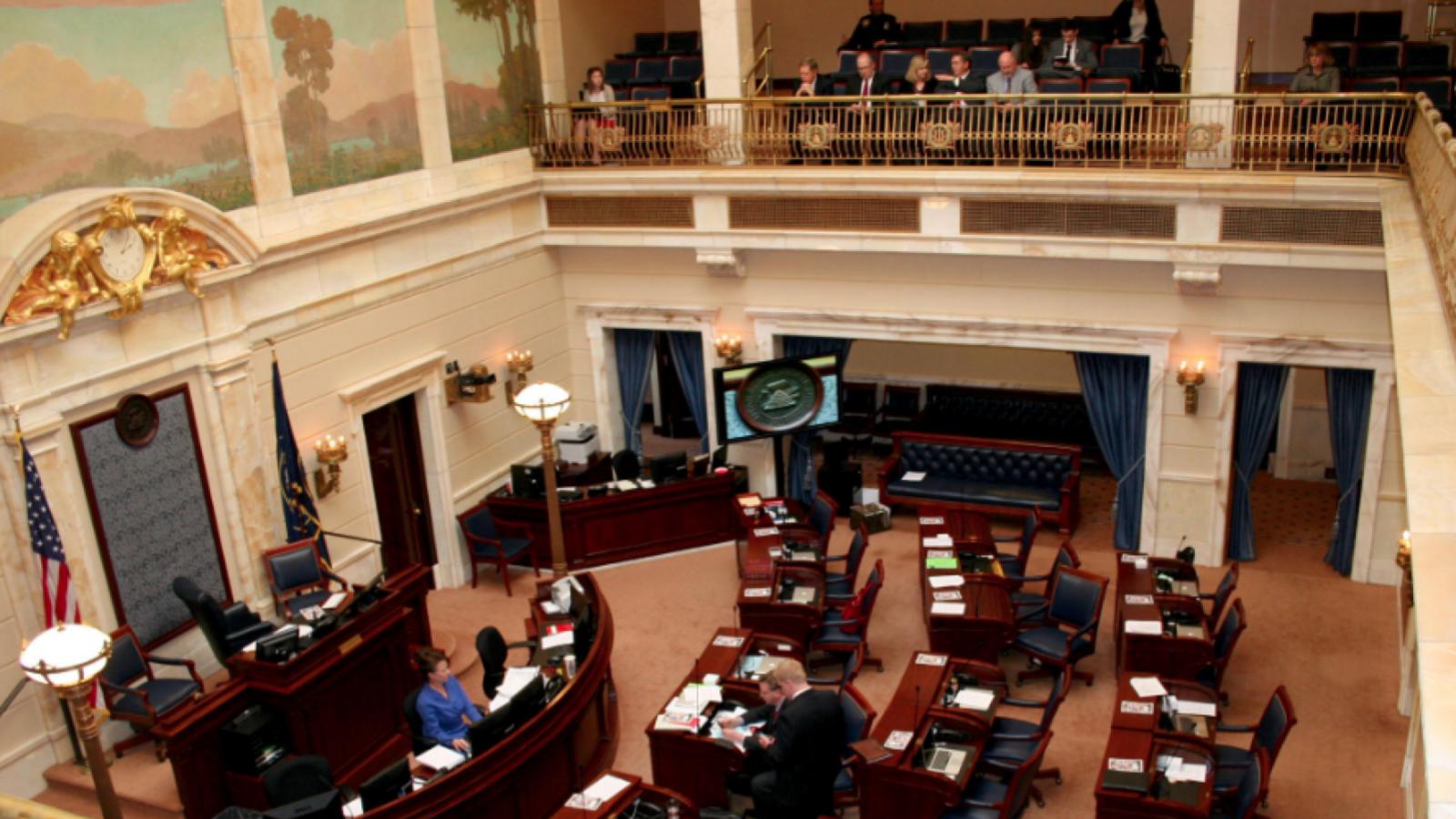
The Utah Constitution assigns legislative power to a part-time citizen legislature that meets each year, beginning on the fourth Monday in January and ending in mid-March. When the legislative session adjourns, senators return home to their homes, families, and regular occupation, to live under the laws they created.
The Utah Senate currently consists of twenty-four men and five women. Occupations include attorneys, businessmen, businesswomen, bankers, educators, an engineer, CPAs, homemakers, a pharmacist, a nurse, a doctor, a dentist, an orthodontist and former university president.
The political makeup of the Utah Senate is about 80 percent Republican and 20 percent Democrat.
OnAir Post: Utah State Senate
About
Source: Government Website
Before statehood
The Utah Territory was established by an act of Congress on Monday, September 9, 1850 which provided for a territorial government made up of a territorial governor chosen every four years, a territorial Assembly with a 13-member council chosen every second year and a 26-member House of Representatives chosen annually, and a territorial Judiciary made up of a Supreme Court, District Courts, Probate Courts, and justices of the peace. The creation of the Territory of Utah was part of the Compromise of 1850 seeking to preserve the political balance of power between the slave and free states.
Following the organization of the territory, Brigham Young was inaugurated as its first governor on Sunday, February 9, 1851 and the first territorial assembly met Monday, September 22, 1851. The legislative body of the Utah Territory continued to act until 1896 with the successful passage of the Utah Constitution and Utah achieving statehood. The first President of the Utah Territorial Senate was Willard Richards and the first Territorial Speaker of the House was William Wines Phelps. In 1870, the length of a Representative’s term was extended to two years, and in 1896 the Utah Territorial Council became the Utah Senate with a four-year term.
After statehood
The Utah Territory was established by an act of Congress on Monday, September 9, 1850 which provided for a territorial government made up of a territorial governor chosen every four years, a territorial Assembly with a 13-member council chosen every second year and a 26-member House of Representatives chosen annually, and a territorial Judiciary made up of a Supreme Court, District Courts, Probate Courts, and justices of the peace. The creation of the Territory of Utah was part of the Compromise of 1850 seeking to preserve the political balance of power between the slave and free states.
Following the organization of the territory, Brigham Young was inaugurated as its first governor on Sunday, February 9, 1851 and the first territorial assembly met Monday, September 22, 1851. The legislative body of the Utah Territory continued to act until 1896 with the successful passage of the Utah Constitution and Utah achieving statehood. The first President of the Utah Territorial Senate was Willard Richards and the first Territorial Speaker of the House was William Wines Phelps. In 1870, the length of a Representative’s term was extended to two years, and in 1896 the Utah Territorial Council became the Utah Senate with a four-year term.
Wikipedia
The Utah State Senate is the upper house of the Utah State Legislature, the state legislature of the U.S. state of Utah.[1] The Utah Senate is composed of 29 elected members, each representing one senate district. Each senate district is composed of approximately 95,000 people.[2] Members of the Senate are elected to four-year terms without term limits. The Senate convenes at the Utah State Capitol in Salt Lake City.
The last elections were held in 2024.
Composition of the Senate
| Affiliation | Party (Shading indicates majority caucus) | Total | ||||
|---|---|---|---|---|---|---|
| Republican | Democratic | Forward | Lib | Vacant | ||
| End of the 59th legislature | 21 | 8 | 0 | 0 | 29 | 0 |
| Beginning of the 60th Legislature | 24 | 5 | 0 | 0 | 29 | 0 |
| End 60th | 23 | 1 | ||||
| 61st Legislature | 23 | 6 | 0 | 0 | 29 | 0 |
| 62nd Legislature | 24 | 5 | 0 | 0 | 29 | 0 |
| 63rd Legislature | 23 | 6 | 0 | 0 | 29 | 0 |
| 64th Legislature | 23 | 6 | 0 | 0 | 29 | 0 |
| 65th Legislature | 23 | 6 | 0 | 0 | 29 | 0 |
| Begin 66th Legislature | 23 | 6 | 0 | 0 | 29 | 0 |
| March 7, 2025[3] | 22 | 1 | ||||
| December 12, 2025[4] | 0 | 28 | 1 | |||
| December 17, 2025[5] | 1 | 29 | 0 | |||
| Latest voting share | 75.9% | 20.7% | 3.4% | |||
Leadership, 66th session
| Position | Name | Party | District |
|---|---|---|---|
| President of the Senate | J. Stuart Adams | Republican | 7 |
| Majority Leader | Kirk Cullimore Jr. | Republican | 19 |
| Majority Whip | Chris H. Wilson | Republican | 2 |
| Assistant Majority Whip | Mike McKell | Republican | 25 |
| Minority Leader | Luz Escamilla | Democratic | 10 |
| Minority Whip | Karen Kwan | Democratic | 12 |
| Assistant Minority Whip | Jen Plumb | Democratic | 9 |
Members of the 66th Senate
Legislative website
Utah Senate staff, under direction of Senate Presidents Waddoups and Niederhauser worked with the House of Representatives, the LFA,[6] and other staff to develop what many have called the best legislative website in the nation. In 2014, le.utah.gov[7] won the NCSL Online Democracy Award.[8] The Utah Legislature previously won this award in 2005.[9]
Past composition of the Senate
See also
Notes
References
- ↑ "Senate Roster | Utah Senate". senate.utah.gov. Retrieved August 11, 2021.
- ↑ Mackun, Paul; Wilson, Steven. "U.S. Department of Commerce Economics and Statistics Administration U.S. CENSUS BUREAU Population Distribution and Change: 2000 to 2010" (PDF). 2010 Census Briefs. United States Census. Retrieved February 16, 2017.
- ↑ Daniel Thatcher (District 11) switched parties from Republican to the Forward Party.
- ↑ Forward Senator Daniel Thatcher (District 11) resigned.
- ↑ Forward Senator Emily Buss appointed to succeed Thatcher.
- ↑ LFA
- ↑ le.utah.gov
- ↑ Legislatures, National Conference of State. "2014 Online Democracy Award". www.ncsl.org. Retrieved October 8, 2017.
- ↑ Legislatures, National Conference of State. "Online Democracy Award Winners". www.ncsl.org. Retrieved October 8, 2017.
External links
- Utah State Senate
- Project Vote Smart - State Senate of Utah
- Utah Republican Party
- Utah Democratic Party

| International | |
|---|---|
| National | |
| Other | |